
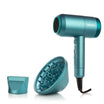


What actually happens inside the Prisma Pro Dryer — and why adjustable airflow changes the game for professional styling.
---
Hair dryers haven't fundamentally changed in decades. Motor spins, element heats, air blows. The innovation has been incremental — lighter motors, quieter fans, marginally better heat distribution. The result is a market full of dryers that work adequately but don't solve the core problem: conventional dryers damage hair because they rely on brute-force heat to evaporate water.
Prisma Ionic technology takes a different approach. Instead of simply pushing hot air faster, it changes how the air interacts with water molecules in the hair and gives the stylist granular control over airflow behavior. Here's how each component works and why it matters.
Far infrared ceramic heating: drying from the inside out
Conventional dryer heating elements warm the air, which then heats the hair's surface. The outer cuticle layer gets hot first, and heat gradually conducts inward. This outside-in approach forces the cuticle to endure the highest temperatures while the water trapped inside the hair shaft — the water you're actually trying to remove — is the last thing to get warm.
Far infrared (FIR) ceramic heaters work differently. They emit infrared radiation at wavelengths that penetrate the hair shaft directly, heating water molecules inside the hair without requiring extreme surface temperatures. The water heats from within and evaporates outward through the cuticle, rather than the cuticle being blasted open by surface heat.
The practical result: drying times drop significantly because you're heating the water directly rather than heating the hair to heat the water. And because surface temperatures stay lower, the cuticle layer remains smoother and more intact. That's where the "less damage" claim comes from — it's not marketing, it's thermodynamics.
Crushed tourmaline: the ionic mechanism
Tourmaline is a semi-precious mineral with a unique property: when heated, it generates negative ions. These negative ions interact with water molecules on the hair's surface, breaking large water droplets into smaller micro-droplets that evaporate faster and absorb into the hair shaft more easily.
The ionic effect also has a direct impact on frizz. Hair becomes frizzy when the cuticle layer lifts and individual strands carry a static charge that causes them to repel each other. Negative ions neutralize this static charge, allowing the cuticle to lie flat. Flat cuticle equals smooth hair, increased light reflection, and the visible shine that clients associate with a professional blowout.
Tiri Pro uses crushed tourmaline gemstones rather than tourmaline-coated surfaces. Crushing increases the mineral's surface area, which increases ion generation. More ions means faster water breakdown and more effective static neutralization — especially noticeable on thick, coarse, or chemically treated hair where frizz control is most challenging.
Adjustable airflow: why it's the feature professionals actually care about
Most dryers give you two or three speed settings — low, medium, high. That's like a car with three gears. It works, but it forces compromises. High speed dries fast but makes precision styling difficult. Low speed gives control but takes forever on thick hair.
The Prisma Pro's Infinity Flow Technology provides continuously adjustable airflow, not stepped settings. The stylist controls exactly how much air moves through the dryer at any moment, matching airflow to the specific task: concentrated, high-velocity air for rough drying wet hair, reduced flow for precision work around the face and edges, moderate flow for round brush blowouts where consistent tension matters more than raw speed.
This matters most during finishing work. The final 20% of a blowout — when the hair is nearly dry and you're setting the style — is where most heat damage occurs because stylists continue applying full-power heat to hair that no longer has much water to evaporate. With adjustable airflow, you reduce flow as the hair dries, maintaining styling control without the excess heat.
The complete system: how the technologies work together
These three technologies aren't independent features bolted onto a conventional dryer. They work as an integrated system.
The far infrared ceramic heater raises the internal temperature of water in the hair shaft. The crushed tourmaline generates ions that break surface water into micro-droplets for faster evaporation. The adjustable airflow lets the stylist calibrate exactly how much convective heat reaches the hair at each stage of the drying process.
The combined effect is measurably faster drying at lower perceived temperatures. For the stylist, that translates to shorter appointment times and happier clients with healthier hair. For the client, it means less heat exposure per session — which compounds over months and years of regular salon visits into noticeably better hair condition.
What this means for your styling routine
Whether you're a professional stylist or someone who blow-dries at home, the practical takeaway is this: the technology in your dryer determines the ceiling of your results. Technique matters, product matters, and brushes matter — but if your dryer is overheating the cuticle to compensate for inefficient water removal, no amount of skill can fully undo that damage.
The shift toward infrared drying, ionic conditioning, and precision airflow control isn't a trend. It's the direction the entire professional category is moving. Understanding the science behind these technologies helps you make informed decisions about the tools you invest in — and helps you explain to clients why their hair looks and feels different after a service with professional-grade equipment.
---
Experience Prisma Ionic technology firsthand. The Prisma Pro Dryer with Adjustable Airflow is available at tiripro.com — with accessories included and free shipping over $50.
Laisser un commentaire
Ce site est protégé par hCaptcha, et la Politique de confidentialité et les Conditions de service de hCaptcha s’appliquent.