

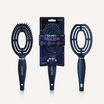
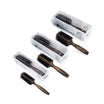
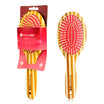
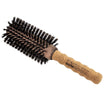
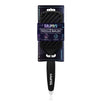
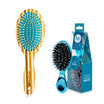

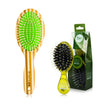
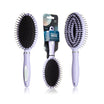
Sustainability in hair tools isn't about sacrifice — the material science behind bamboo brushes gives them genuine performance advantages over plastic alternatives.
---
The conversation around eco-friendly beauty tools usually frames sustainability as a trade-off. You go green, you give up something — performance, durability, or professional quality. With hair brushes, that assumption is wrong. The properties that make bamboo an environmentally responsible material also make it a functionally superior brush handle and body.
This isn't marketing spin. It's material science.
The antimicrobial advantage
Bamboo contains a natural bio-agent called "bamboo kun" that gives it inherent antimicrobial properties. This matters enormously for a tool that contacts scalps, collects sebum, and lives in warm, humid salon environments. Plastic brush handles have no antimicrobial properties — they're essentially inert surfaces that harbor whatever bacteria lands on them.
In a professional salon setting where a single brush might contact dozens of clients in a week, the antimicrobial quality of bamboo isn't a nice-to-have. It's a genuine hygiene advantage that reduces the bacterial load between cleanings.
Weight and ergonomics
Bamboo is roughly 30% lighter than the injection-molded plastics used in most consumer brushes. For a tool you hold in your hand for hours each day — as salon professionals do — that weight difference compounds. Less fatigue means more control, especially through the final appointments of a long day.
The natural grain of bamboo also provides a subtle texture that improves grip without requiring rubberized coatings. Plastic handles need added grip materials that wear out and peel over time. Bamboo's grip improves as it develops a natural patina with use.
Durability that surprises
Bamboo has a higher tensile strength than many hardwoods and most plastics used in brush manufacturing. A well-constructed bamboo brush handle won't crack from being dropped, won't warp from heat exposure during blow-drying, and won't develop the stress fractures that plague plastic handles after months of daily salon use.
The common concern — "Won't bamboo get ruined by water?" — is addressed through proper sealing during manufacturing. Quality bamboo brushes use food-grade sealants that protect against moisture without adding chemicals that contact the hair or scalp. The sealed bamboo becomes essentially waterproof while retaining its structural advantages.
The sustainability case, honestly
Bamboo is the fastest-growing plant on earth. Some species grow up to three feet per day. It requires no pesticides, no fertilizers, and regenerates from its own root system after harvesting — meaning the plant isn't killed when the bamboo is collected. It produces 35% more oxygen than an equivalent stand of trees and absorbs significantly more carbon dioxide.
Compare that to the petroleum-based plastics in conventional brushes, which take hundreds of years to decompose and are rarely recycled in practice. Even "recyclable" plastic brushes end up in landfills because the mixed materials (plastic, rubber, metal pins, nylon bristles) make them impractical to process.
The honest caveat: bamboo brushes aren't zero-impact. They still require manufacturing, shipping, and eventually disposal. But their lifecycle impact is dramatically lower than plastic alternatives, and the bamboo itself is a genuinely renewable resource.
Pairing bamboo with natural bristles
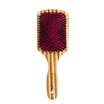
The performance case for bamboo handles becomes even stronger when combined with natural wooden or boar bristles. A fully natural brush — bamboo body, wooden bristle pins, boar bristle — creates a tool where every component contributes to hair health rather than just occupying space.
Wooden bristle pins on a bamboo paddle brush provide gentle, flexible detangling that doesn't generate static the way nylon pins do. Static is the enemy of smooth styling — it lifts the cuticle layer, creates flyaways, and undoes the work of conditioning treatments. A natural-material brush eliminates this problem entirely.
Making the switch
For stylists or consumers considering the transition from plastic to bamboo, the adjustment is minimal. The brushing technique is identical. The only difference you'll notice is the lighter weight and the absence of static — both improvements.
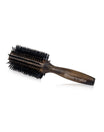
Start with a bamboo paddle brush for daily detangling and oil distribution. If the performance difference convinces you — and it will — expand to bamboo-handled round brushes and travel minis. A complete bamboo brush collection costs roughly the same as a mid-tier plastic set, lasts longer, and performs measurably better on the metrics that matter: shine, smoothness, and scalp health.
---
Discover Tiri Pro's eco-friendly bamboo brush collection — sustainably sourced, salon-caliber performance, trusted by professionals.
Dejar un comentario
Este sitio está protegido por hCaptcha y se aplican la Política de privacidad de hCaptcha y los Términos del servicio.